History of Spider Solitaire
Spider Solitaire is one of the most played card games ever created. Here’s how it came to be.
Origins
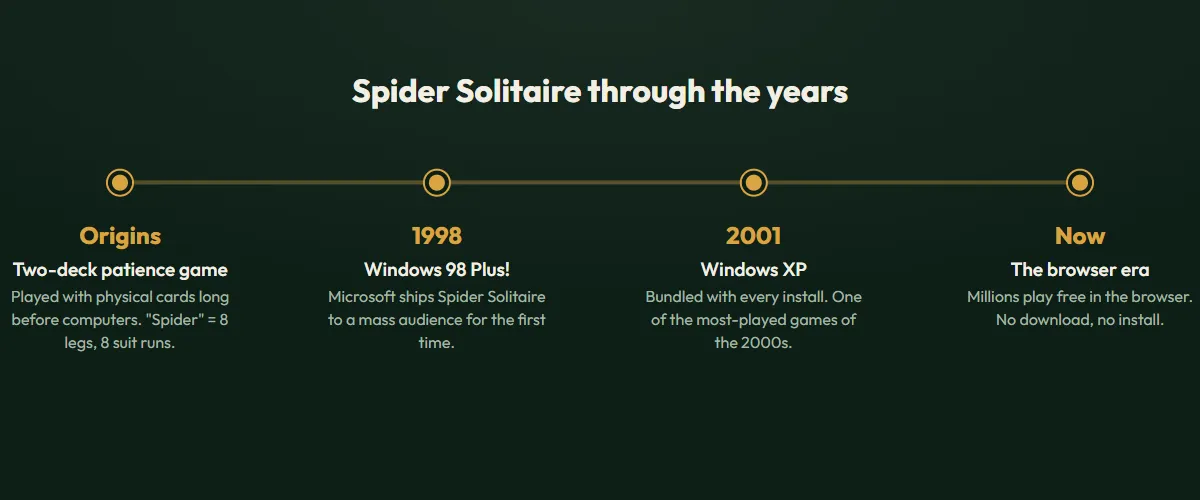
Spider Solitaire has murky origins as a physical card game, likely predating computers by decades. The name “Spider” is said to come from the spider’s 8 legs, one for each of the 8 suit sequences you need to complete to win.
The game uses two standard 52-card decks and belongs to the broader family of patience (solitaire) games.
The Windows Era
Spider Solitaire became a global phenomenon when Microsoft included it in Windows 98 Plus! in 1998. It was later bundled directly into Windows XP (2001), where it became one of the most-played games of the 2000s.
At its peak, Windows XP had hundreds of millions of installations worldwide, which means Spider Solitaire was likely being played by tens of millions of people daily.
Microsoft’s Implementation
Microsoft’s original Spider Solitaire popularised the three difficulty modes still used today:
- 1-suit (beginner): all spades
- 2-suit (intermediate): spades and hearts
- 4-suit (advanced): all four suits
This became the accepted standard, and virtually every Spider Solitaire implementation uses these same three modes.
The Modern Web Era
As Windows’ built-in games moved online or were removed, web-based Spider Solitaire sites filled the gap. Today, millions of players play Spider Solitaire through browser-based games, with no installation required.
The game’s appeal comes from its balance: it’s simple enough to learn in five minutes, but has enough depth and difficulty variation to remain interesting for years.
Why It’s Still Popular
Spider Solitaire hits a sweet spot:
- Accessible: easy rules, no opponent needed
- Challenging: genuine strategy is rewarded
- Replayable: random shuffles create unlimited unique games
- Satisfying: the feeling of a completed suit run is hard to beat