How to Play Spider Solitaire
Spider Solitaire uses two 52-card decks (104 cards total), dealt across 10 columns. Move cards onto any card one rank higher to build descending sequences. Complete a full 13-card run in the same suit (King down to Ace) and it clears automatically. Remove all 8 suit runs to win.
That’s the whole game. Everything else is about making good decisions within those constraints.
Play Spider Solitaire now →. No download, no login.
What You’re Looking At
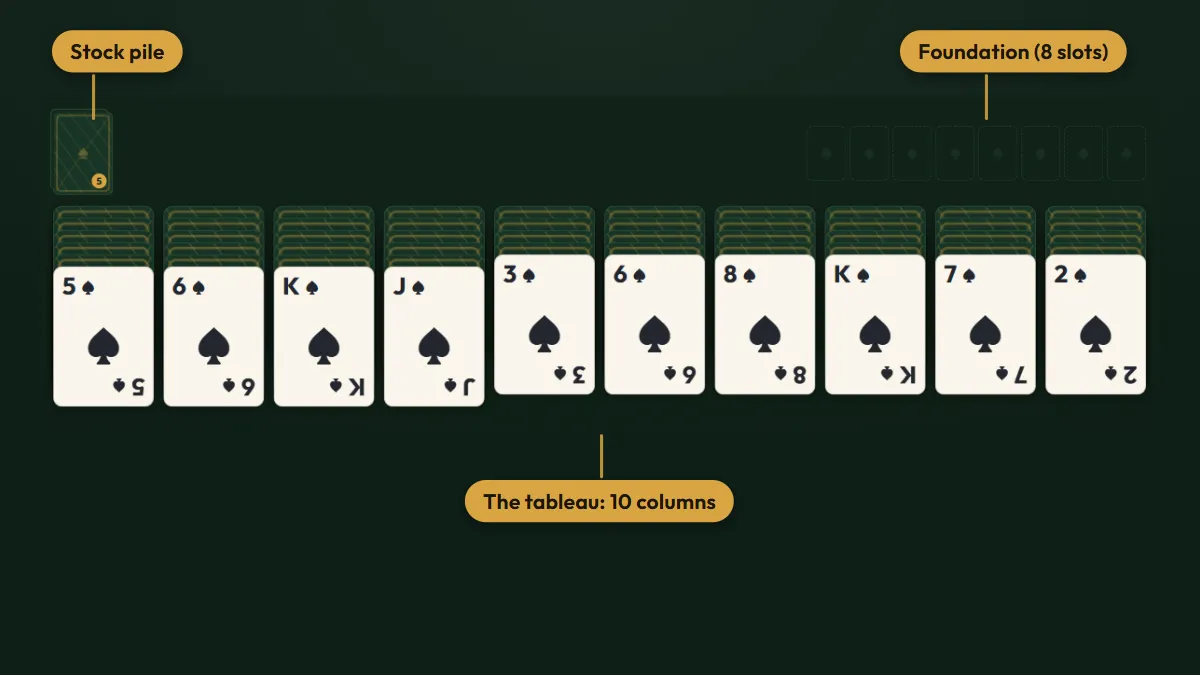
Open the game and you’ll see three areas:
The tableau: 10 columns of cards in the centre. This is where the game happens. At the start, columns 1-4 have 6 cards each; columns 5-10 have 5 cards each. Only the top card of each column is face-up. Everything underneath is hidden.
The stock pile: a stack of 50 cards in the corner, dealt face-down. When you run out of moves, you deal from here: one card to each column, all at once.
The foundation: 8 empty slots where completed suit runs go when you clear them from the tableau. Your score for the game.
At the start of a 1-suit game, you’re looking at 54 cards (44 face-down, 10 face-up) and 50 in reserve. Most of the game is the work of turning those hidden cards over.
The One Rule You Need to Know
Any face-up card can be placed on any face-up card that is exactly one rank higher.
That’s it. A 7 goes on an 8. A Queen goes on a King. Suit doesn’t matter for basic placement.
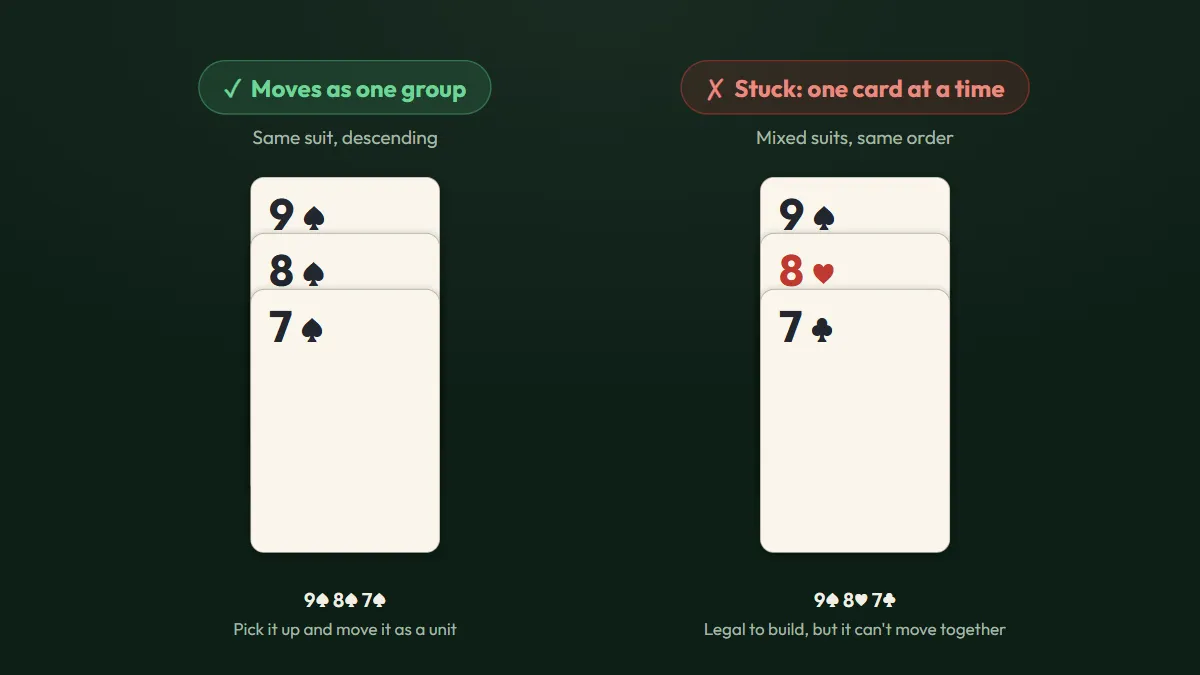
Where suit does matter: moving a group of cards together. If you want to pick up a stack and move it as a unit, every card in that stack must be the same suit in a descending sequence. A 9♠ 8♠ 7♠ stack moves as one piece. A 9♠ 8♥ 7♣ stack? You’d have to move each card individually.
This distinction is the entire strategic depth of the game. Mixed-suit sequences look like progress but they trap you. Same-suit sequences are the only ones that score.
Moving Cards: Step by Step
Step 1: Find a legal move
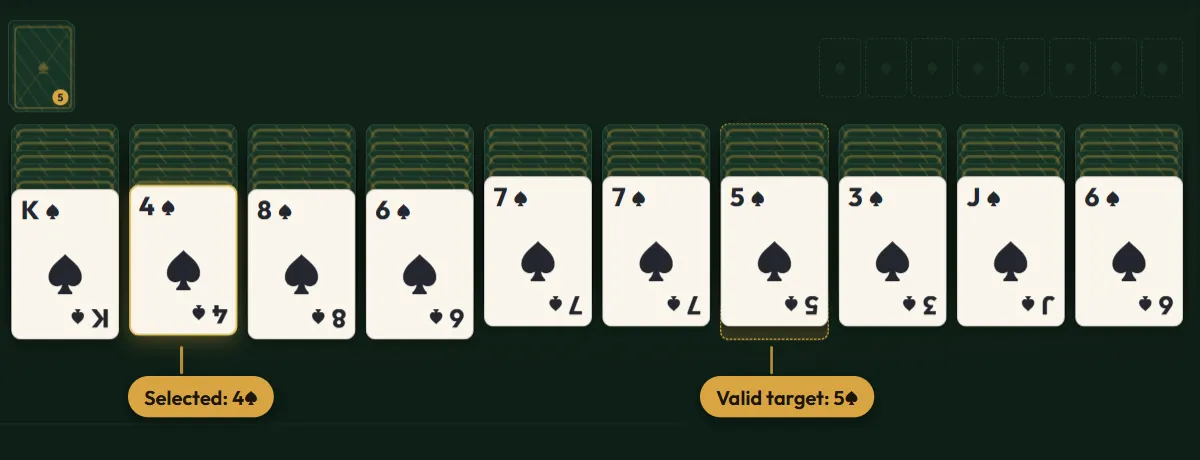
Look at the face-up cards across all 10 columns. Any card can move to a column where the top card is one rank higher. Scan for these opportunities before touching anything.
On 1-suit, every move is legal because everything is spades, so there are no suit conflicts. On 2-suit and 4-suit, you’re constantly choosing between moves that build same-suit sequences (valuable) and moves that don’t (potentially costly).
Step 2: Move the card (or group)
Click or drag the card you want to move. If you’re moving a group, click the bottom card of the group and the game selects the whole valid sequence above it.
On 4-suit, a stack of mixed suits won’t move as a group even if it looks like a sequence. You’ll need to move them individually.
Step 3: Check what you’ve uncovered
Every move that reveals a face-down card is almost always a good move. That hidden card could be exactly what you need. Prioritise revealing cards over rearranging face-up ones.
Step 4: Use empty columns as staging areas
If a column is completely cleared, it becomes a temporary holding space. You can move any card (or any valid group) there while you rearrange other columns. Empty columns are the most powerful resource in the game. Don’t fill one casually.
Dealing from the Stock
When you’ve exhausted your options (no moves feel useful, you’ve checked everything), click the stock pile.
This deals one card face-up to each of the 10 columns simultaneously. All 10, no choice. You can do this 5 times per game (50 cards total).
Two things to know before you deal:
- You can’t deal if any column is empty. Fill all empty columns first, or you’ll be locked out of the stock.
- Deals are irreversible. Those 10 new cards cover whatever was on top. If you were working toward a sequence, that progress might get buried. Use Undo if you deal and immediately regret it.
A common beginner mistake: dealing too early, too often. The stock feels like a lifeline. In practice, each deal covers your in-progress sequences with cards that may or may not help. Hold off until you’ve genuinely explored every useful move.
Completing a Suit Run
When the top 13 cards of any column form a complete same-suit sequence (K, Q, J, 10, 9, 8, 7, 6, 5, 4, 3, 2, A, all in the same suit), they clear automatically.
The cards lift off the tableau, move to the foundation, and you get +100 points. The column they were in either collapses to the card below (if there were cards underneath) or becomes empty.
Eight of these wins the game.
On 1-suit, this happens fairly naturally: every sequence you build is same-suit by default. On 2-suit and 4-suit, you might spend half the game building a long run, only to find the last two cards are the wrong suit. Planning ahead matters a lot more.
Your First Game: A Quick Walkthrough
Here’s how to approach your first 1-suit game, move by move.
Opening moves: Look at the 10 face-up cards. Identify any card that can move onto another face-up card. Make those moves. After each move, check the newly exposed face-down card. If it’s now the top card, it flips face-up and gives you new options.
Early priority: Get as many face-down cards flipped as possible. You’re mostly blind at the start. Every face-down card is a locked option. The faster you reveal them, the more choices you have.
Mid-game: You’ll start seeing longer runs forming. Try to consolidate same-suit sequences into single columns. A column with K-Q-J-10-9-8 all in spades is far more useful than that same stretch split across two columns.
When you get stuck: Don’t deal immediately. Use the Hint button; it shows the highest-priority legal move. Use Undo to try something different. Only deal when you’ve genuinely exhausted options.
Finishing: Toward the end, you’ll start clearing full suit runs. Each one creates space and momentum. The last few runs often come quickly once you clear the first couple.
First game won’t go perfectly. That’s normal. The beginner tips page covers the specific habits that shorten the learning curve.
Difficulty Levels: What Actually Changes
Spider Solitaire has three modes, and they’re genuinely different games.
| Mode | Suits in play | Can move groups? | Approximate win rate | |---|---|---|---| | 1-Suit (Easy) | Spades only | Yes (every sequence is same-suit) | 90%+ | | 2-Suit (Medium) | Spades + Hearts | Only same-suit sequences | 50-70% | | 4-Suit (Hard) | All four suits | Only same-suit sequences | 6-10% |
The win rate numbers are real. On 4-suit, even experienced players lose more games than they win. The ~6-10% win rate is for people who know what they’re doing. Beginners landing on 4-suit and bouncing in frustration is common.
1-suit is the right starting point. Not because it’s easy, but because it teaches the core mechanics without the suit-management layer. Every move you make is a potential same-suit sequence. You learn to read the board and plan sequences without the cognitive overhead of tracking four suits simultaneously.
2-suit adds spades and hearts. Now some of your natural-looking moves produce mixed sequences that can’t move as groups. You start having to think about whether a move is actually good or just looks good.
4-suit is the full game. Every move involves a tradeoff between short-term accessibility and long-term sequence quality. The satisfaction of winning a 4-suit game is proportionally high, because you actually earned it.
Start with 1-suit. Move to 2-suit when you’re winning comfortably. 4-suit when you’re ready for a genuinely hard game.
The Daily Challenge runs on 1-suit, so everyone playing that day gets the same deck. Good place to start once you’ve got the basics down.
Common Mistakes That Kill Beginner Games
These aren’t theoretical errors. They’re the specific patterns that cause most losses.
Dealing too early. The stock feels like a safety valve. Deal as a last resort, not when you feel stuck. “Stuck” usually means you haven’t looked hard enough.
Ignoring face-down cards. Newer players focus on building long visible sequences. But the cards you can see are already available; the cards you can’t see are your growth. Move cards off piles with lots of face-down cards first.
Filling empty columns with random cards. An empty column is temporary storage. Putting a mid-rank card there just because you can is almost always a waste. Keep it empty until you have a specific sequence to build through it.
Building long mixed-suit sequences. A 10-card sequence looks impressive. But if it’s mixed suits, it can’t move as a group and can’t score. You’ve essentially locked those 10 cards together. This is especially punishing in 4-suit.
Forgetting undo exists. There’s no penalty for undoing moves. If you’re not sure about a move, make it and see what opens up, then undo if it doesn’t help. You can undo all the way back to the start of the game.
Ignoring the hint button. Hint shows the highest-priority move available. Use it when you’re stuck. It won’t penalise you, and over time, you’ll start seeing the same patterns it shows you without needing to ask.
Trying 4-suit first. If your first game is 4-suit, you’ll probably lose badly and not understand why. Start with 1-suit, understand what same-suit sequences feel like to build, then step up.
Scoring
You start each game with 500 points. Every move costs 1 point. Every completed suit run adds 100 points.
A completed 4-suit game with minimal moves can score over 1,000: the 8 suit runs add 800 points, and if you used fewer than 300 moves, you finish ahead.
Score is mostly a personal benchmark rather than a competitive one (global leaderboards are coming). The interesting metric is moves per win. As you improve, you’ll solve the same games faster with fewer wasted moves.
Frequently Asked Questions
How many cards are in Spider Solitaire? 104 cards: two standard 52-card decks shuffled together. 54 are dealt to the tableau at the start, 50 go into the stock pile.
Is Spider Solitaire always winnable? No. Not every deal is mathematically winnable, especially on 2-suit and 4-suit. Win rates for experienced players are roughly 90%+ on 1-suit, 50-70% on 2-suit, and 6-10% on 4-suit. If a game feels impossible, it might be. Deal with it by starting fresh.
Can I move any card onto any other card? Almost. Any face-up card can go on any face-up card that’s exactly one rank higher, regardless of suit. The one restriction: you can’t place a card on an Ace (nothing goes below Ace). And you can’t move groups unless they’re a same-suit descending sequence.
Why can’t I deal from the stock? One column is empty. The rule is that all 10 columns must have at least one card before you can deal. Move a card into the empty column first, then deal.
Does undo affect my score? On this site, no. Undo as many times as you like; it won’t penalise your score or move count beyond reversing the moves you made.
What’s the difference between Spider Solitaire and regular Solitaire (Klondike)? Spider uses 104 cards across 10 columns; Klondike uses 52 cards across 7. In Klondike, you build sequences by alternating colour (red on black). In Spider, any card goes on any card one rank higher, but only same-suit sequences score or move as groups. Spider is generally considered harder, especially at 2-suit and 4-suit.
Is there a Daily Challenge? Yes. The Daily Challenge gives every player the same shuffled deck each day. Different deck every day, same one for everyone playing on that day. Personal results are saved locally.
What to Read Next
- Spider Solitaire Rules: the full ruleset in one place, including edge cases
- Strategy Guide: how to actually win more games, with the decision framework experienced players use
- Beginner Tips: 10 specific habits that shorten the learning curve
- 4-Suit Spider Solitaire: if you’re ready for the hard version
Explore by Topic
- What Is Spider Solitaire?: the basics, terms, and how it differs from regular Solitaire
- Suits & Decks: how the 1, 2, and 4-suit versions change the game
- How to Win: winning tactics for each difficulty
- Scoring: how points work and what a good score looks like
- Benefits & Difficulty: what the game does for your focus, and why it gets hard