Spider Solitaire Rules
Spider Solitaire is played with 104 cards (two standard 52-card decks) dealt across 10 tableau columns. Move cards to build descending sequences. Complete 8 same-suit runs of 13 cards each (King to Ace) to win. Cards can be placed on any card one rank higher regardless of suit, but only same-suit sequences score or move as groups.
Play Spider Solitaire →. The rules in action, no download needed.
Equipment and Setup
Cards: Two standard 52-card decks shuffled together. 104 cards total.
Suits in play (depends on difficulty):
- 1-suit: Spades only (all 104 cards are spades)
- 2-suit: Spades and hearts (52 of each)
- 4-suit: All four suits, 26 of each (spades, hearts, clubs, diamonds)
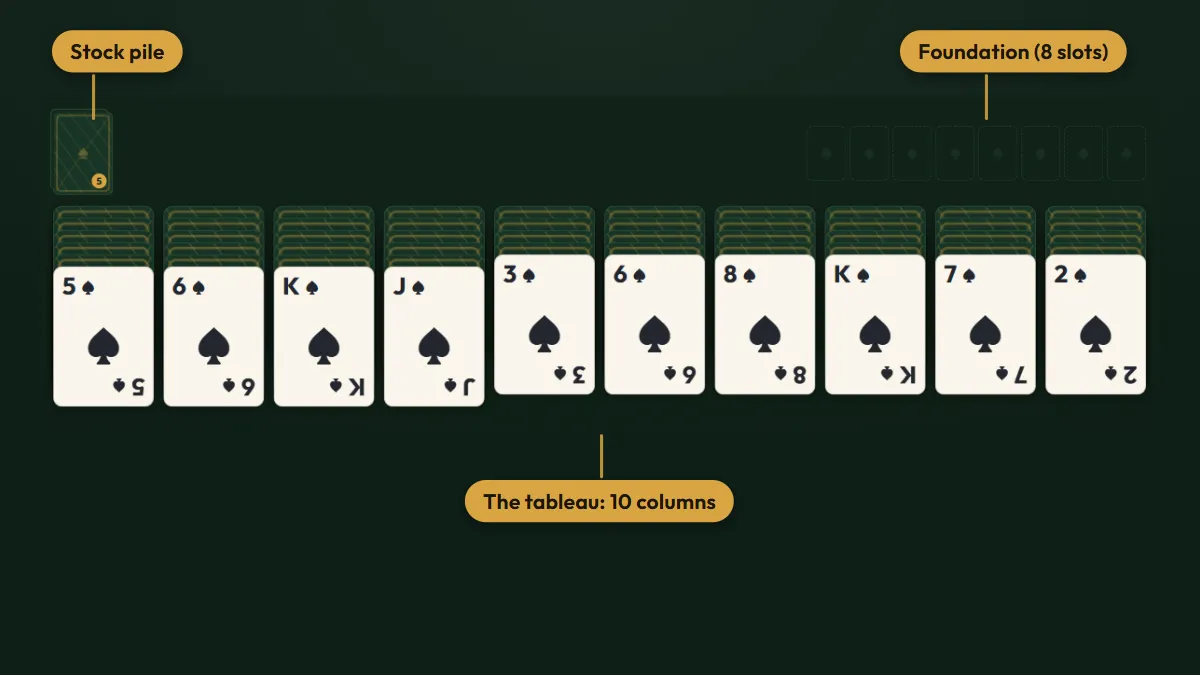
Tableau: 54 cards dealt into 10 columns.
- Columns 1–4: 6 cards each (5 face-down, 1 face-up on top)
- Columns 5–10: 5 cards each (4 face-down, 1 face-up on top)
Stock pile: The remaining 50 cards, held face-down. Dealt 5 times during the game (10 cards at a time, one to each column).
Foundation: 8 empty slots where completed suit runs are placed when cleared from the tableau.
Valid Moves
Moving a Single Card
Any face-up card can be placed on any face-up card that is exactly one rank higher, regardless of suit.
| Card to move | Valid destinations | |---|---| | Ace (A) | Cannot be placed on any card; only goes to foundation as part of a completed run | | 2 | Any 3 (any suit) | | 7 | Any 8 (any suit) | | Queen (Q) | Any King (any suit) | | King (K) | Empty columns only (nothing ranks above a King) |
A face-down card cannot be moved. Only the top face-up card of a column (or a valid group) is available to move at any time.
Moving a Group of Cards
A group of cards can only be moved together if every card in the group forms a same-suit descending sequence: consecutive ranks, all the same suit, in order from high to low.
Valid group (moves as one unit): 9♠ 8♠ 7♠ 6♠
Invalid group (cannot move together): 9♠ 8♥ 7♠ (mixed suits, must move individually)
This is the central rule of Spider Solitaire. Mixed-suit sequences look like sequences but behave like individual cards for movement purposes. On 1-suit this never comes up (everything is spades). On 2-suit and 4-suit it’s constant.
Empty Columns
An empty tableau column accepts any single card or any valid group. There are no restrictions on what can go into an empty column.
Empty columns matter more than almost anything else in the game. They act as temporary staging areas, letting you move cards out of the way while rearranging sequences elsewhere. See the strategy guide for how to use them effectively.
What You Cannot Do
- Place a card on a card of the same rank (a 7 cannot go on a 7)
- Place a card on a card of lower rank (a 7 cannot go on a 6 or lower)
- Place any card on an Ace (Aces are the lowest card and have no valid placements beneath them)
- Move a face-down card
- Move a mixed-suit sequence as a group
- Deal from the stock if any tableau column is empty (all 10 columns must have at least one card)
Dealing from the Stock
When no useful moves remain, click the stock pile to deal.
What happens: One card is dealt face-up to each of the 10 tableau columns simultaneously. All 10 columns receive a card; you don’t choose which columns.
The empty column restriction: You cannot deal if any column is empty. All 10 must contain at least one card first. This prevents you from stacking the deal in your favour.
How many deals: The stock contains 50 cards, dealt in 5 rounds of 10. Once the stock is exhausted, no more dealing is possible.
Reversibility: Dealing can be undone. If you deal and immediately want to reverse it, Undo restores the pre-deal state.
Completing a Suit Run
When the top 13 cards of any tableau column form a complete same-suit sequence (K, Q, J, 10, 9, 8, 7, 6, 5, 4, 3, 2, A, all the same suit), the run is automatically removed from the tableau.
The run moves to the foundation and scores +100 points. If there were cards beneath the completed run, the column collapses to the card underneath. If the completed run was the only cards in the column, it becomes empty.
Eight completed suit runs wins the game.
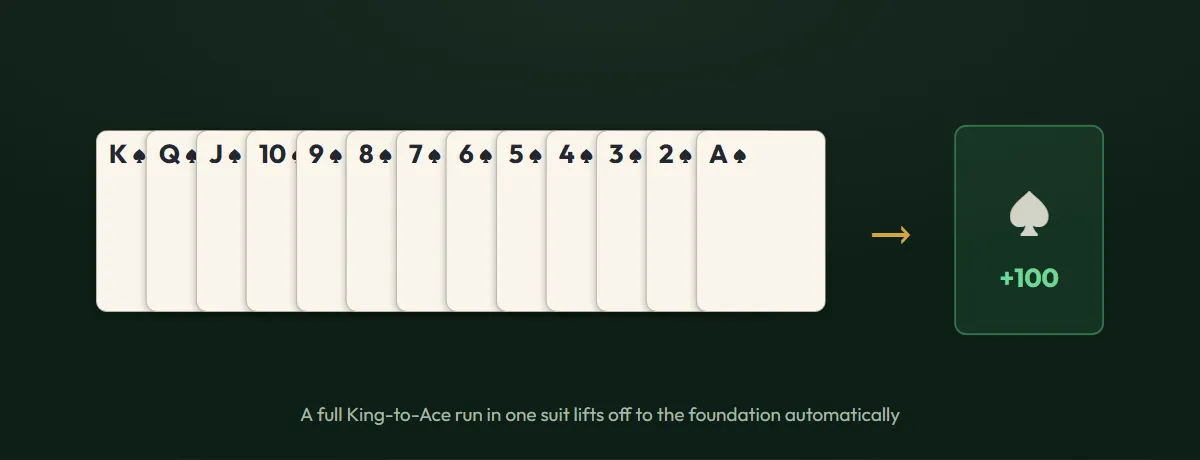
Note: the 13-card sequence must appear at the top of a column in order. You can’t skip cards or complete a run mid-column: the sequence must be consecutive from the current top card down.
Scoring
| Event | Points | |---|---| | Starting score | 500 | | Each move made | −1 | | Each completed suit run | +100 |
Worked example: You play a game, make 312 moves, and complete all 8 suit runs.
- Start: 500
- Moves: −312
- Suit runs: 8 × 100 = +800
- Final score: 988
A perfect game is theoretically possible but extremely rare in practice. On 4-suit, completing a game in under 200 moves with 8 suit runs gives a score above 1,100. Most winning games on 4-suit fall somewhere between 600 and 900.
Score decreases with every move, which is why avoiding unnecessary moves matters for your final number, not just for efficiency. Cross-suit moves that don’t advance a sequence cost points without benefit.
How Rules Change by Difficulty
The core rules are the same across all three modes. What changes is how much the suit restriction affects your options.
| Rule | 1-Suit | 2-Suit | 4-Suit | |---|---|---|---| | Cards in play | Spades only | Spades + Hearts | All four suits | | Can place any card on any card one rank higher? | Yes | Yes | Yes | | Can move a group? | Yes (always same-suit) | Only same-suit sequences | Only same-suit sequences | | How often can you move groups? | Every sequence qualifies | Roughly half of sequences | Rarely, until late game | | Suit tracking required? | No | Some | Constant | | Approximate win rate (experienced players) | 90%+ | 50–70% | 6–10% |
On 1-suit, the group movement rule is irrelevant: since every card is a spade, every descending sequence is automatically same-suit. The game becomes purely about sequencing and column management.
On 2-suit, about half of your sequences will be mixed-suit. You constantly choose between moves that build same-suit (slower, more strategic) and moves that build mixed-suit (faster, more flexible, but the sequence can’t move as a group).
On 4-suit, building a moveable group requires cards of the same suit to be in consecutive positions in a column. This almost never happens naturally; you have to deliberately engineer it. Most sequences in a 4-suit game are mixed-suit and can’t move as groups until you sort them.
Can You…? Quick Rules Reference
Can you move a card onto a card of a different suit? Yes. Any card can go on any card exactly one rank higher, regardless of suit. Suit only matters for group movement and scoring.
Can you move a group of cards from different suits? No. A group must be same-suit and descending to move together. Move mixed-suit sequences one card at a time.
Can you put a King in an empty column? Yes. Kings can only go in empty columns (nothing ranks higher than a King). You can also put any other card or valid group in an empty column.
Can you undo as many times as you want? On this site, yes: unlimited undo, all the way back to the start of the game, with no score penalty for the undo action itself. (You still lose the points from the moves you’re undoing.)
Can you deal from the stock whenever you want? You can deal any time as long as all 10 columns have at least one card. You don’t have to wait until you’re stuck, though dealing early is usually bad strategy.
Can you move cards back from the foundation? No. Once a completed suit run moves to the foundation, it stays there.
Can you win without using the stock? Theoretically yes, but extremely unlikely. The stock is a normal part of the game. Using it too early is the mistake most beginners make.
What happens when you run out of moves and stock? The game is over. You can undo back to a point where more options existed, or start a new game. Not every deal is winnable; this happens occasionally even with good play, especially on 4-suit.
Related Pages
- How to Play Spider Solitaire: if you want the rules in tutorial format with a first-game walkthrough
- Strategy Guide: how to apply these rules to actually win more games
- Spider Solitaire FAQ: common questions about scoring, modes, and gameplay
- 4-Suit Spider Solitaire: the hardest mode, where the group movement rule shapes every decision
Explore by Topic
- What Is Spider Solitaire?: the basics, key terms, and how it compares to regular Solitaire
- Suits & Decks: how the 1, 2, and 4-suit versions differ, and how many cards you need
- Scoring: how points work and what counts as a good score
- Is Spider Solitaire Winnable?: win rates and odds for every difficulty