Spider Solitaire Strategy Guide
Most Spider Solitaire strategy advice is a flat list of tips with no sense of priority. “Build same-suit sequences.” “Don’t deal too early.” Fine. But which of those matters more? When does one override the other? What do you actually check before touching a card?
This guide is organised differently. It starts with a decision framework you run before every single move, then covers how that framework applies across the three phases of a game.
Play Spider Solitaire → to test these as you read.
The Move Decision Framework
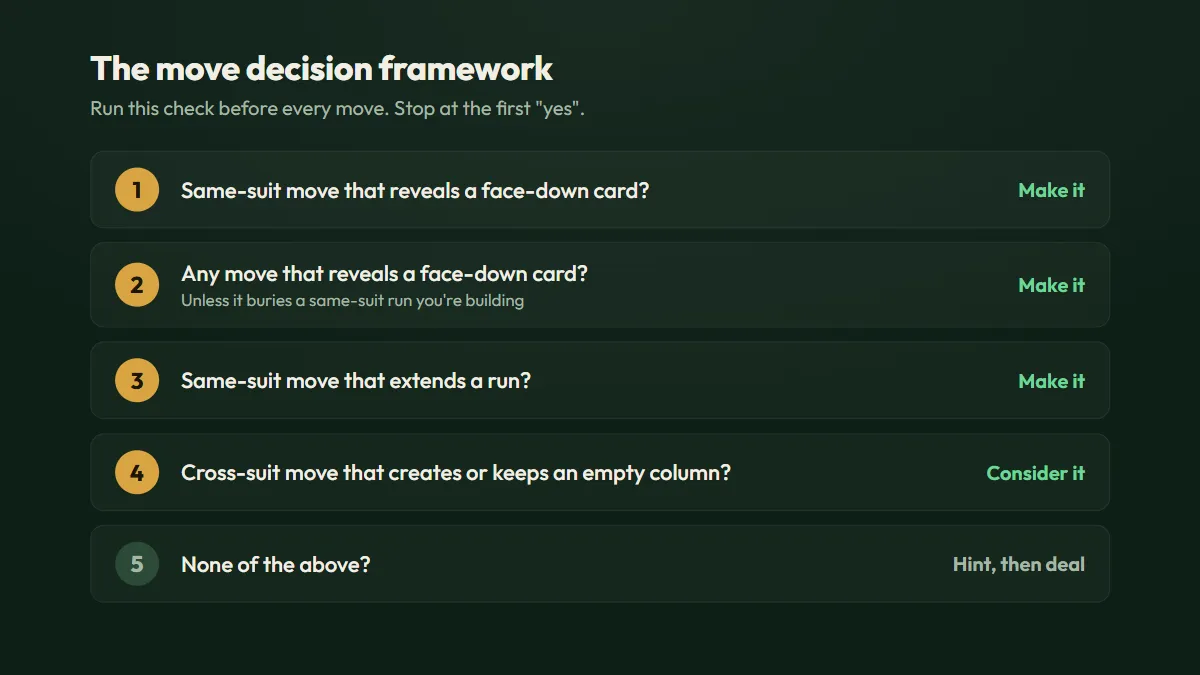
Before touching any card, run this check in order. Stop at the first “yes.”
- Is there a same-suit move that reveals a face-down card? Make it.
- Is there any move that reveals a face-down card? Make it, unless it buries a same-suit sequence you’re actively building.
- Is there a same-suit move that doesn’t reveal a face-down card but extends an in-progress run? Make it.
- Is there a cross-suit move that creates or preserves an empty column? Consider it carefully.
- None of the above? Use Hint. If Hint shows nothing useful, deal from the stock, but only after checking every column twice.
That’s the whole strategy compressed into five questions. Everything below is explaining why this order is right, and what good execution looks like at each stage.
Why Win Rates Are Lower Than You Think
Before getting into tactics, it helps to understand the actual difficulty you’re up against.
Experienced players, meaning people who understand the framework above and apply it consistently, win roughly:
- 1-suit: 90%+ of games
- 2-suit: 50–70% of games
- 4-suit: 6–10% of games
That last number surprises people. A 4-suit game is theoretically winnable about 35% of the time with perfect play. But perfect play doesn’t exist, which is why actual win rates fall to single digits for most players. Even at the expert level, losing 4-suit games isn’t failure. It’s just probability.
This matters strategically because it changes how you should feel about abandoning a game. On 4-suit, a bad position at move 40 is often genuinely unrecoverable. Spending 30 more minutes confirming that isn’t strategy. Knowing when to quit is.
Phase 1: Opening Moves (Moves 1–30)
The opening is almost entirely about one thing: revealing face-down cards as fast as possible.
You start with 44 face-down cards and 10 face-up. The face-up cards are your complete information. Everything else is locked. Until you start flipping cards, you’re playing with roughly 10% of the information available.
Find columns with the most face-down cards. At the start, columns 1–4 have 6 cards each (5 face-down, 1 face-up). Columns 5–10 have 5 cards each (4 face-down, 1 face-up). Prioritise moving cards off the taller columns first.
Every face-up card you can move off a tall column is the right move. Even if it’s a cross-suit move. Even if it breaks a short sequence you started. The information gain from flipping a face-down card is almost always worth more than preserving a two-card sequence.
Here’s a concrete example. You have an 8♠ sitting on a column with 5 cards underneath it. There’s a 9♥ available. You could move that 8 onto the 9 (cross-suit, nothing special), but it flips a face-down card. Do it. Now you have new information and a new move option. That’s worth the mixed-suit sequence.
Don’t start building long sequences yet. The temptation in the opening is to find a King and start building toward it. Resist. You don’t know what’s hidden. Building a long run on a column locks cards in place that might need to move later. Keep things fluid.
The one exception: if you can clear a column entirely in the opening, do it. An empty column in the first 20 moves is enormously valuable and worth any cross-suit awkwardness it creates.
Phase 2: Mid-Game (Moves 31–80)
By move 30 or so, most face-down cards are flipped, you have a better picture of what you’re working with, and the game’s real structure becomes visible. This is where strategy diverges sharply based on difficulty.
On 1-suit
Everything is same-suit, so your only job is sequencing efficiently. Look for the longest sequences you can build and consolidate them into single columns. If you have 8♠ 7♠ in one column and 9♠ in another, combine them. Then look for the 10♠ to extend. At 1-suit, the mid-game is mostly about keeping your columns organised so the endgame is straightforward.
Empty columns on 1-suit should be used to stage cards while you move sequences around. Don’t leave a King in an empty column unless you’re already building a sequence onto it. Kings block movement, and one sitting isolated wastes the space.
On 2-suit and 4-suit
This is where the same-suit priority really starts to bite. Every cross-suit sequence you build is a liability. It can’t move as a group. It can’t score. And it locks those cards together, which limits your options for everything else.
Track your in-progress suit runs. You’re building toward 8 completed runs, each requiring 13 cards. On 4-suit, you have 26 cards of each suit across 104 cards: 2 complete King-to-Ace runs per suit. Know which suits you’re furthest along on and focus there.
The empty column budget. This is the single most important concept in mid-game 4-suit play. An empty column lets you move a sequence of up to 2 cards through it as a staging area. Two empty columns lets you move sequences of up to 4 cards. The formula: n empty columns = 2^n cards you can effectively move in a single operation.
So: 3 empty columns means you can move an 8-card sequence in one coordinated operation. That’s a lot of power. Spend your empty columns on moves that matter, not just because a space opened up.
When to deal. Deal only when you’ve genuinely exhausted the move decision framework: gone through all five steps, found nothing. Before dealing, scan every column twice. The move you’re missing is usually a same-suit option you haven’t spotted yet. When you do deal, look at the 10 new cards immediately and ask: what did this open up? What did it bury? Is there a same-suit move among the new cards?
Phase 3: Closing Runs (Endgame)
The endgame starts when you’ve completed your first suit run. That first cleared run creates an empty column (or extends an existing empty one), which multiplies your available moves significantly.
At this point, winning is mostly a momentum problem. Each completed run creates more space, which enables the next run, which creates more space. If you reach the endgame with 2–3 completed runs and no catastrophically buried cards, you’ll usually finish.
The danger: deep face-down cards under long cross-suit sequences. If you’ve built a 10-card mixed-suit run on a column and there are 4 face-down cards underneath it, you need to unwind that run before you can access those cards. That might require 3 empty columns just to stage the unwind. Plan for this before it happens.
When multiple runs are close to completion, finish the longest one first. The empty column it creates accelerates everything else.
Undo aggressively in the endgame. When you’re close, a wrong move can lock you out. Don’t push forward if a move feels uncertain. Undo and look for an alternative.
4-Suit Specific Tactics
4-suit Spider is a different game, not just a harder one. Here’s what changes.
Colour-pair before suit-sorting. When you have a completely chaotic column (multiple suits, no obvious order), aim for red/black alternation first (hearts/diamonds together, spades/clubs together), then sort by specific suit within colour. Getting to colour-paired is a meaningful intermediate goal.
Never build a cross-suit sequence longer than 4 cards. On 4-suit, a 5+ card mixed sequence is almost impossible to unwind without 3 empty columns. If you catch yourself building one, stop. Move the new card elsewhere, even if there’s no ideal spot.
Suit isolation. Pick one or two suits to complete first and route cards of those suits to dedicated columns as much as possible. If you’re targeting spades, every time a spade appears, ask whether it can go somewhere that advances the spade run. Don’t let spades get buried in random columns if you can help it.
The 6–10% win rate is not evenly distributed. Some 4-suit deals are very nearly unwinnable regardless of skill; others are genuinely solvable with careful play. When you’re stuck at move 50 with no empty columns and a stock that’s nearly exhausted, the game may be dead. Recognising that and starting fresh is better than grinding.
When to Quit a Game
This one’s underrated. Most strategy guides don’t mention it.
A game is likely dead when all of these are true at once:
- Stock is exhausted (or on the last deal)
- No empty columns exist
- No same-suit moves are available
- The remaining face-down cards are buried under cross-suit sequences you can’t unwind
You can spend 20 minutes verifying this. Or you can start a new game. On 4-suit, recognising a dead game early is itself a strategic skill: it keeps you engaged with games that are actually winnable rather than grinding through ones that aren’t.
On 1-suit and 2-suit, it’s rarer to hit a truly dead position: the cross-suit movement flexibility means there’s almost always something to try. But it does happen, especially if you’ve been dealing aggressively and burying progress.
The Habits That Separate Good Players
A few specific habits come up in everyone who wins consistently at 2-suit and 4-suit.
They look before they move. Not a glance, an actual scan of all 10 columns before touching anything. The move decision framework is worthless if you apply it to the first card that catches your eye.
They use Undo before dealing. Before clicking the stock, they undo the last few moves to check whether a different sequence would have opened something up. Dealing is permanent. Undoing is free.
They track their suit runs mentally. They know how many cards of each suit are face-up, roughly where the key cards are, and which run is closest to completion. It isn’t obsessive, just the difference between reactive play and directed play.
They ignore the timer. Playing faster doesn’t help. Playing more deliberately does. If the site shows a timer, treat it as irrelevant until you’ve won enough games to care about speed.
Quick Reference
| Priority | Move type | When to make it | |---|---|---| | 1 | Same-suit move + reveals face-down card | Always | | 2 | Any move + reveals face-down card | Usually (check it doesn’t bury a run) | | 3 | Same-suit move, no new card revealed | If it advances a near-complete run | | 4 | Cross-suit move that creates/preserves empty column | Only if the column is genuinely needed | | 5 | Cross-suit move, no other benefit | Last resort before dealing | | 6 | Deal from stock | Only after exhausting all of the above |
Where to Go Next
If the framework above makes sense and you want to go deeper:
- Advanced Strategy: supermoves, the empty column budget worked out in full, 4-suit pattern recognition, and how to read a dead position
- Beginner Tips: if you’re still in the early stages and want habit-building before tactics
- How to Play: if any of the terms above (stock, suit run, face-down cards) aren’t fully clear yet
- 4-Suit Spider Solitaire: ready to test the strategy against the hardest mode